← Projects
InfrastructureL2Fraud ProofsGoHosted

How does an optimistic rollup catch a lying sequencer?

This is a hosted lab with a Go backend and local Anvil chains. You watch an optimistic dispute next to a mock validity path, including bonds, challenge windows, and what the ZK lane does not prove.

Technical A Next.js frontend and Go service coordinate loopback-only Anvil chains, optimistic batch bonds, Merkle-bisection disputes, and a mock validity lane that re-executes a batch witness. Hosted at eth-l2.vercel.app. The ZK path is illustrative and does not generate succinct proofs.

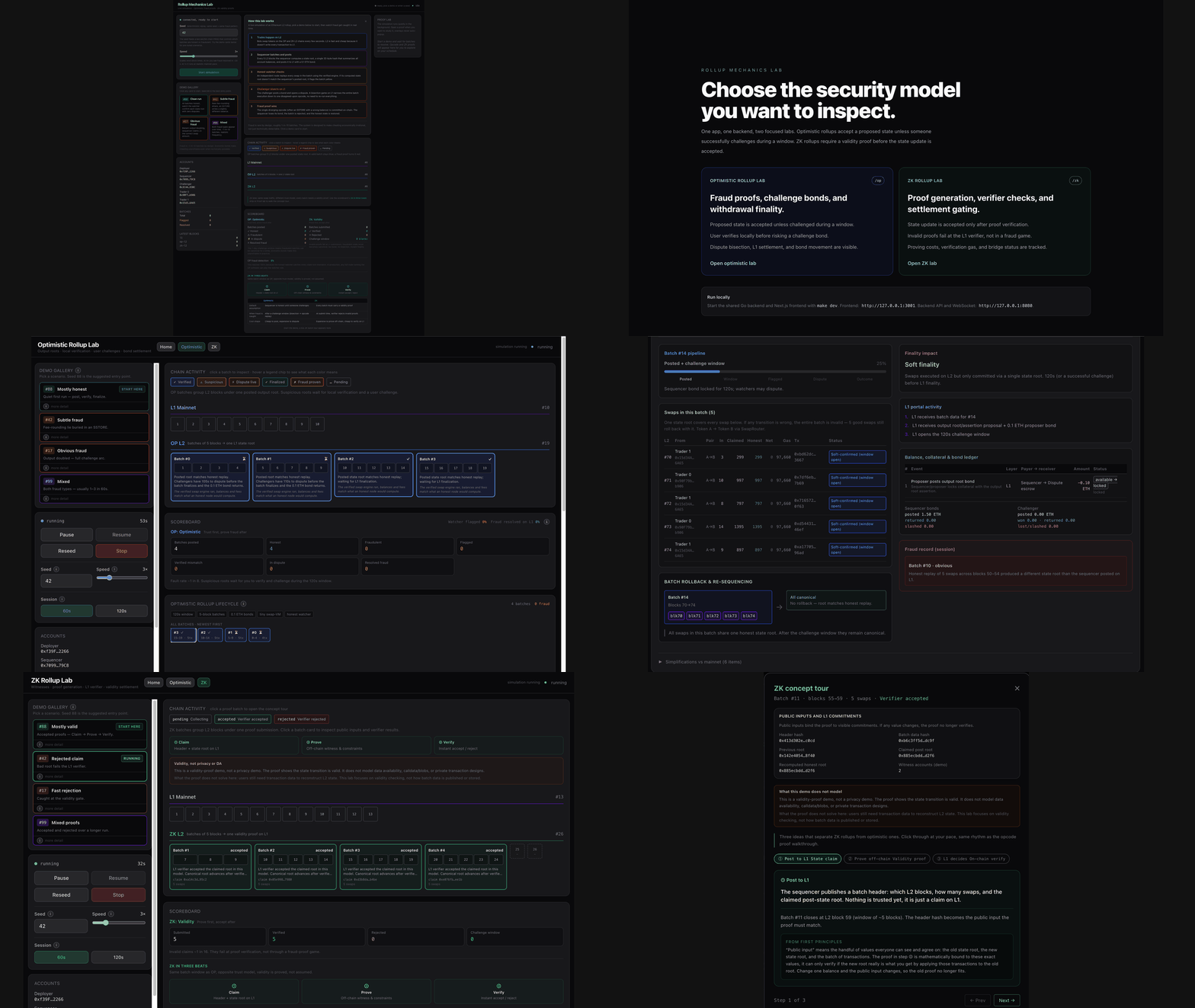
Rollup Mechanics Lab demo

Problem

Rollup fraud proofs and validity proofs are usually explained in prose or slides. This lab lets a visitor watch a lying sequencer get caught by an optimistic fraud proof, then compare that mechanism side by side with a validity-proof lane, in one interactive session.

What I designed and implemented

  • Designed the overall lab structure: an optimistic lab at /op and a ZK-style lab at /zk, sharing one Go backend and one Next.js frontend.
  • Designed the bond and challenge-window economics, and the WebSocket event vocabulary that drives the frontend visualizations.
  • Implemented a Go backend that spawns three local Anvil chains (L1, an optimistic L2, and a ZK-style L2) and a seeded-PRNG sequencer that occasionally posts a bad state root.
  • Implemented Solidity contracts for bond posting and Merkle-bisection fraud proofs with on-chain one-step re-execution (FraudProofGame, SwapStepVM), plus a separate ZkRollupMock / ZkValidityVerifier path that re-executes a batch witness on L1.
  • Implemented the hosted split: a Vercel frontend reached over a Cloudflare Tunnel by a Go API running on an Ubuntu VPS.

Architecture

  • A Go orchestration process spawns and manages three Anvil chains (L1, an optimistic L2, and a ZK-style L2); Anvil stays loopback-only and idle-stops after a session ends.
  • Solidity contracts: OptimisticPortalMock (batch posting, bonds, challenge window, finalization), FraudProofGame (Merkle bisection over swap-VM traces with on-chain one-step re-execution), SwapStepVM (the step machine being re-executed), and ZkValidityVerifier / ZkRollupMock (the validity-lane submission and witness re-execution).
  • A Go API and WebSocket service (/stream) emits typed events: block_mined, batch_posted, batch_flagged, batch_verified, batch_challenged, dispute_stage, dispute_resolved, bond_settled, zk_inspect_ready.
  • The Next.js frontend renders a lab chooser, then /op (batch canvas, Block Inspector, Optimistic Tracker) and /zk (proof-batch canvas, concept tour, public-input panel, validity/DA caveats).
  • Hosted split: Vercel Next.js frontend, same-origin API rewrites, Cloudflare Tunnel, Go API on an Ubuntu VPS (managed by systemd), loopback-only Anvil chains spawned on demand.

Engineering decisions

  • Used a seeded PRNG for the fraud-injection rate (about 1 in 8 optimistic batches) and invalid-claim rate (about 1 in 16 ZK batches) so a reviewer can reliably see both the honest and dishonest path in a short live session, instead of waiting on random chance.
  • Required a human to click 'Verify locally' and choose to post a bond rather than auto-challenging, which mirrors real challenger economics but means the fraud path does not resolve automatically without user action.
  • Used L1 witness re-execution for the /zk lane instead of building or wiring in a real SNARK/STARK circuit, to demonstrate the validity-vs-optimistic mechanics tradeoff at the scope of a portfolio project rather than a research-grade cryptography implementation.

Verification and testing

  • Foundry/Solidity tests per contract family: OptimisticPortal.t.sol, FraudProofGame.t.sol, ZkRollup.t.sol, ZkValidityVerifier.t.sol, DisputeGame.t.sol, SwapEngines.t.sol, TradeEngine.t.sol.
  • Go unit tests in the backend: internal/seed/prng_test.go, internal/sourcemap/sourcemap_test.go, internal/trace/diff_test.go, internal/watcher/honest_test.go, internal/config/ports_test.go, internal/server/security_test.go, internal/server/idle_stop_test.go.
  • Deterministic scenario tuning (the fraud and invalid-claim injection rates above) so both the honest and dishonest paths are observable within one short demo session.

Limitations and what is simulated

  • All three chains are local Anvil instances, not public testnets or mainnet.
  • The /zk lab's validity check is L1 witness re-execution inside ZkValidityVerifier, a deterministic re-run of the batch witness. It is a simplified, mock validity-verification path used as a stand-in for a succinct proof, not a real zero-knowledge proving system: there is no SNARK/STARK circuit, no succinct proof generation, and no succinct verifier.
  • Bond sizes (0.1 ETH), the 120-second challenge window, and the batch window (5 L2 blocks) are demo-scale values chosen for a short live session, not production economic-security parameters.
  • The app never auto-challenges a flagged batch; a human has to click through the verify and bond flow for the dispute path to resolve.

Production differences

  • A production optimistic rollup runs a roughly 7-day challenge window (versus 120 seconds here), posts to a public L1, and has independently operated challenger infrastructure.
  • A production ZK rollup generates and verifies a real succinct zero-knowledge proof, for example a SNARK or STARK circuit compiled from the state-transition function, rather than re-executing a witness directly on L1.

Lessons

  • Comparing both rollup designs side by side in one app made the tradeoff between the optimistic challenge window and a validity proof's upfront verification cost far more concrete than describing either mechanism in isolation.

Live lab

Rollup Mechanics Lab

One app, one backend, two focused labs: /op for optimistic fraud proofs and /zk for a simplified, mock validity-verification path standing in for a succinct ZK proof. The live UI runs on its own Vercel app at eth-l2.vercel.app; simulation uses a staging Go backend through Cloudflare Tunnel.

Backendapi-staging-eth-l2.magro.dev
InteractOpens the Vercel app (not an in-site /demos route)
Agent briefllms.txt
Not checked

Click check to query the staging backend.

Origin: https://api-staging-eth-l2.magro.dev

Short demo

Full demo